Looking for a privacy-friendly Alexa alternative?
Meet Gladys Assistant, the local, open-source smart home platform that keeps your data at home instead of in Amazon's cloud.
Amazon Alexa is convenient, but everything you say is processed in Amazon's cloud, tied to your account, and can be used to build a profile of you. Since March 2025, Amazon no longer even offers the option to keep voice requests on the device: they all go to its cloud. For a lot of people, that's a deal-breaker.
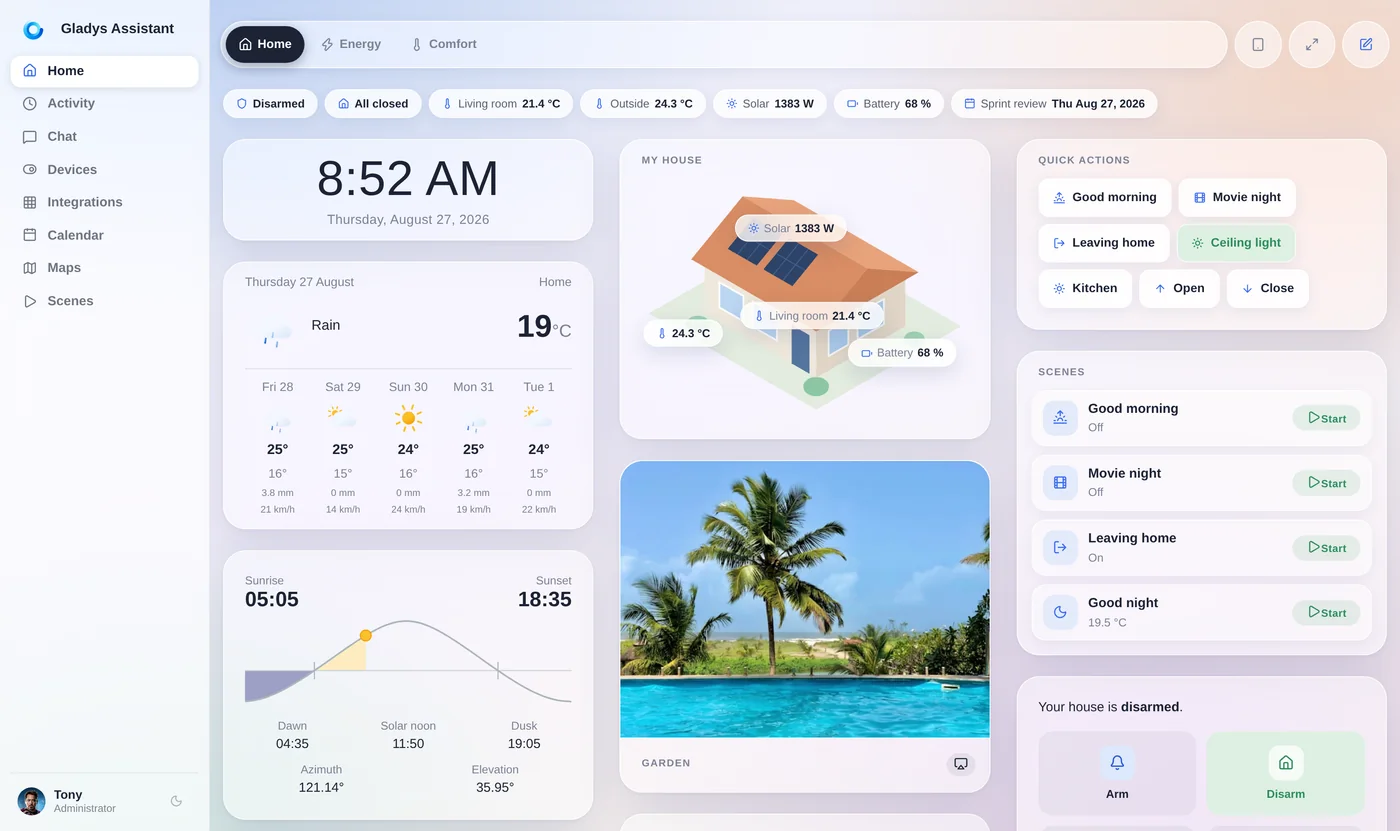
Gladys Assistant takes the opposite approach. It's a free, open-source, self-hosted smart home platform that runs at home, on your own machine. Your devices and automations stay on your local network, with no mandatory cloud, no recordings on someone else's servers, no ads and no data resale.
Why look for an alternative to Alexa?
Alexa is a polished voice assistant, but its cloud-first, ad-driven model comes with real trade-offs. The most common reasons people start looking for an alternative:
- Everything you say is sent to Amazon's cloud, and voice recordings can be stored on its servers.
- Your usage feeds personalization and advertising profiles across Amazon's services.
- It needs an Amazon account and a constant internet connection; very little works offline.
- Amazon can discontinue devices, change features, or update its privacy terms at any time.
- It's a voice front-end, not a real automation engine: genuinely local, complex automations are limited.
None of this makes Alexa a bad product, it's great at understanding voice. It's simply a question of priorities, and if privacy and local control matter to you, there's a better foundation for your smart home.
Why Gladys is a great privacy-friendly Alexa alternative
Gladys runs on your own machine, so your smart home data stays on your local network. No mandatory cloud, no recordings on Amazon's servers, no tracking.
Because it runs locally, your home keeps working even if your internet drops or a cloud service is shut down. Your automations don't depend on Amazon staying online.
Gladys has a full scenes engine with triggers, conditions and actions. You build a home that reacts on its own, not just one that waits for voice commands.
Gladys has its own voice assistant: talk naturally from your dashboard, a wall tablet or your phone. It runs on open-weight AI models hosted in France, not on Amazon's servers, and nothing you say is used for ads.
Zigbee, Matter and MQTT are first-class citizens, so you're never locked into one brand's ecosystem or forced to buy compatible accessories.
Gladys is 100% free and open-source at its core. There are no ads, no data resale, and an optional Gladys Plus subscription funds the project transparently.
Being fair: where Alexa has the edge
Let me be transparent. Alexa is excellent at what it does: best-in-class voice recognition, natural conversation, a huge ecosystem of skills, very cheap speakers, and multi-room audio that just works. Gladys is a home automation platform first, and its voice assistant is newer and something you set up yourself, so Alexa is hard to beat as a pure consumer voice speaker.
The good news is that it doesn't have to be all or nothing. Gladys can integrate with Alexa, so you can keep voice control on your existing Echo devices while your automations run locally in Gladys. And if privacy is your priority, you can go fully local and drop the cloud assistant entirely. Either way, you stay in control.
Other privacy-friendly alternatives to Alexa
Gladys isn't the only option. To be fair, here are the main alternatives if you want more privacy and local control than Alexa offers:
A powerful open-source platform with a local voice option (Assist). Very capable, but with a steep learning curve and some YAML.
More privacy-conscious than Alexa, but still tied to Apple's ecosystem and cloud, and limited to Apple hardware.
Open-source voice assistants focused on privacy. Promising, but more of a tinkerer's project than a polished consumer product.
A fully offline voice toolkit that pairs with other platforms. Very private, but technical to set up and maintain.
Among these, Gladys stands out by combining a clean, modern interface, a real local automation engine, and open standards, without the steep learning curve.
Frequently asked questions
Is there a privacy-friendly alternative to Alexa?
Yes. Gladys Assistant is a local, open-source, self-hosted smart home platform that runs on your own machine, so your data stays on your local network instead of in Amazon's cloud. There are no recordings on someone else's servers, no ads and no data resale.
Does Alexa record everything you say?
Alexa processes your voice requests in Amazon's cloud, and voice recordings can be stored on its servers and used to personalize services. Gladys takes the opposite approach: it runs locally, so your smart home data stays at home.
Can I replace Alexa with a local, self-hosted system?
Yes. Gladys Assistant is fully self-hosted and runs at home, with a real automation engine, so your scenes keep running locally. It also has its own voice assistant (with Gladys Plus), so you can move away from Amazon while keeping hands-free control.
Does Gladys work without the cloud or internet?
Yes. Gladys' core runs entirely on your local network, so your home keeps working even if your internet drops or a cloud service is shut down. An optional Gladys Plus subscription adds remote access and AI, but the self-hosted core stays local.
Does Gladys have a voice assistant like Alexa?
Yes. Gladys has a voice assistant widget for your dashboard, wall tablet or phone: you speak naturally, and it controls devices, reads sensors, runs scenes and answers questions. It is part of Gladys Plus and runs on open-weight AI models hosted in France (Scaleway), not on Amazon's or Google's servers, with no ads and no data resale. It's newer than Alexa, and there's no dedicated speaker yet.
Does Alexa still process voice requests locally?
No. In March 2025, Amazon removed the "Do Not Send Voice Recordings" setting from the few Echo devices that supported it, so every Alexa voice request is now sent to Amazon's cloud. With Gladys, your devices and automations run on your own hardware, at home.
Is there an open-source, self-hosted Alexa alternative?
Yes. Gladys Assistant is free, open-source (Apache 2.0) and self-hosted: it runs on a mini-PC, a Raspberry Pi or a NAS at home, and works with Zigbee, Matter, Philips Hue, SmartThings, Sonos and many other devices. Other open-source options include Home Assistant (Assist), OpenVoiceOS and Rhasspy.
Can I keep using Alexa with Gladys?
Yes. Gladys can integrate with Alexa, so you can keep voice control on your Echo devices while your automations run locally in Gladys. If privacy is your priority, you can also go fully local and drop the cloud assistant entirely.
Try the privacy-friendly Alexa alternative
Gladys is free, open-source, and installs in a single Docker command. Local-first, self-hosted, no cloud required, no recordings on someone else's servers.